


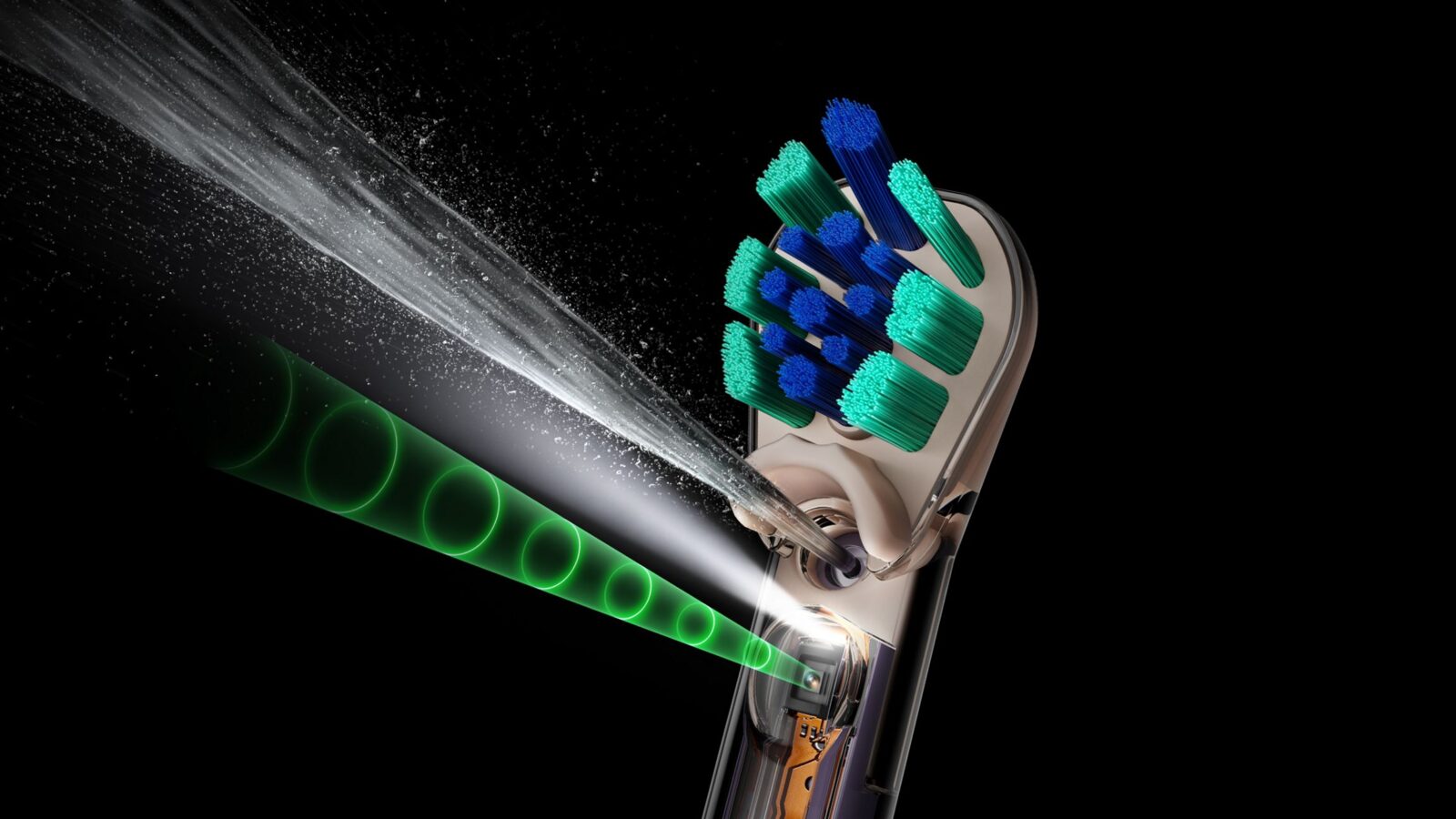

Dyson has entered the oral-care market with a product that is unlike any conventional electric toothbrush. The Dyson CameraJet combines an electric toothbrush, targeted interdental cleaning system, miniature camera, artificial intelligence, and smartphone connectivity into a single device. Rather than simply vibrating or oscillating a brush head, Dyson has designed the CameraJet to see the spaces between your teeth, identify them using machine learning, and direct a small jet of mouthrinse into those areas while you brush.
At $499.99 in the US, it is unquestionably a premium product. The real question is whether all this technology provides a meaningful advantage over a good electric toothbrush combined with conventional interdental cleaning.
What is the Dyson CameraJet?
The Dyson CameraJet is Dyson’s first electric toothbrush and is essentially a toothbrush + precision water flosser + intraoral camera in one system.
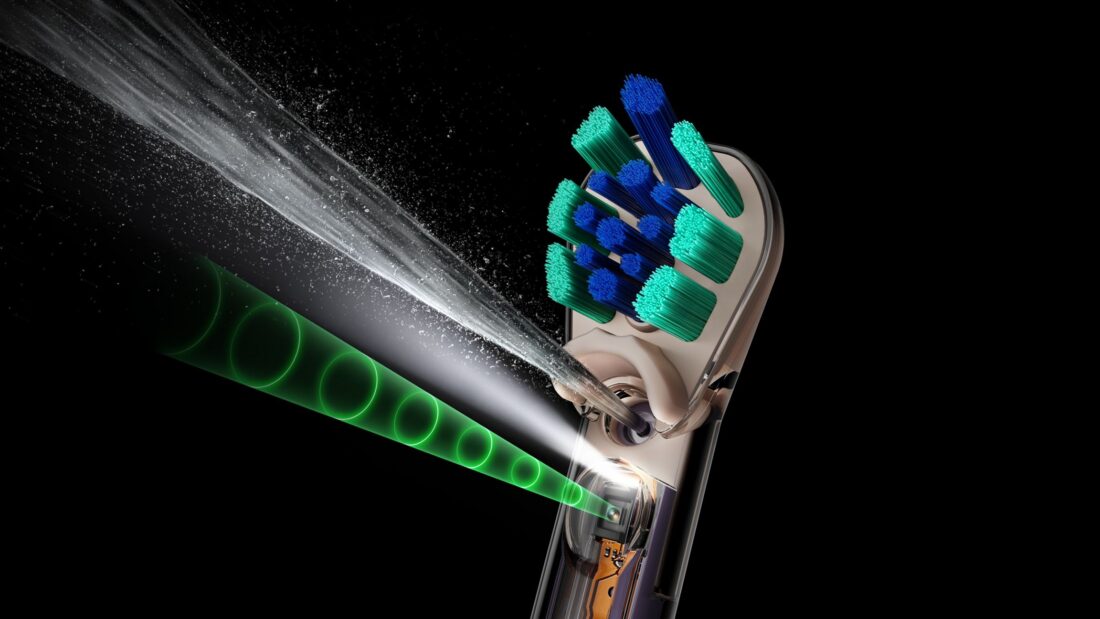
Its main innovation is called Gap Optical Targeting™. A 100,000-pixel macro-lens camera captures 28 images per second, while a machine-learning algorithm analyzes the images to identify interdental gaps. The device then directs a pressurized jet of mouthrinse toward those areas.
The system is designed to make interdental cleaning part of the brushing process rather than requiring the user to separately floss or use an interdental-cleaning device.
Key Features
1. Built-in camera
The most unusual feature is the integrated 100k-pixel macro camera. Unlike conventional smart toothbrushes that estimate brushing position through sensors, CameraJet actually captures images of the teeth and uses them to identify interdental spaces. Dyson states that the camera analyzes 28 images every second.
The MyDyson app can also provide visual feedback during brushing.
2. AI-powered Gap Optical Targeting™
The camera feeds information to a machine-learning system that identifies interdental gaps.
When a gap is detected, the device can activate its precision jet and deliver mouthrinse directly into that region. This is the core technology that differentiates CameraJet from conventional electric toothbrushes.
3. Precision interdental jet
The CameraJet incorporates a conical jet capable of delivering up to approximately 0.15 mL of liquid between teeth. Dyson describes this as precision-flossing rather than simply rinsing the mouth. The jet can activate rapidly, with the company stating that the diaphragm pump can deliver a targeted burst in as little as one-tenth of a second.
This could be particularly interesting for users who struggle with conventional flossing.
4. Dual-bristle brush head
The brush head uses a contoured dual-bristle design intended to follow tooth contours and clean along the gingival margin.
The brush head also contains RFID technology to monitor usage and wear, helping indicate when replacement is required.
5. MyDyson app integration
The toothbrush connects with the MyDyson ecosystem, providing guided brushing and access to the camera-based features.
This makes CameraJet more than a conventional powered toothbrush—it is designed as a connected oral-health device.
6. Battery and water resistance
According to Dyson, the CameraJet provides approximately 10 days of battery life and has an IPX7 water-resistance rating. Charging is through a USB-C-to-pogo-pin system.
7. Specialized toothpaste
One important consideration is that the CameraJet requires a non-foaming toothpaste for the camera system to function correctly. This is an important difference from conventional electric toothbrushes, where users can generally use their preferred toothpaste.
Specifications at a Glance
| Feature | Dyson CameraJet |
|---|---|
| Product type | Electric toothbrush + precision interdental jet |
| Camera | 100k-pixel macro lens |
| Imaging | 28 images/second |
| AI | Gap Optical Targeting™ |
| Interdental jet | Conical precision jet |
| Brush head | Contoured dual-bristle |
| Brush-head tracking | RFID |
| Battery life | Up to 10 days |
| Water resistance | IPX7 |
| Charging | USB-C to pogo-pin |
| App | MyDyson |
| Weight | Approx. 0.51 lb / 231 g |
| Tank capacity | Approx. 0.67 fl oz |
| Dock reservoir | Approx. 6.76 fl oz |
| US price | $499.99 |
| Availability | Newly launched; regional availability varies |
Specifications are based primarily on Dyson’s published product information.
What I Like About the Dyson CameraJet
1. It addresses interdental cleaning
This is arguably the most interesting aspect of the product.
Traditional electric toothbrushes primarily address plaque on accessible tooth surfaces and along the gingival margin. Interdental plaque remains a separate challenge. CameraJet attempts to incorporate interdental cleaning into the brushing process itself.
For people who frequently forget to floss, integrating targeted interdental cleaning into their brushing routine could potentially improve adherence.
2. The technology is genuinely innovative
The camera-based approach is not simply another “smart toothbrush” with an app.
The combination of:
Camera → AI analysis → gap detection → targeted jet
creates a genuinely different brushing workflow.
Dyson says the product was developed using extensive imaging and engineering work, and the company has positioned the device as a new approach to oral hygiene rather than simply a premium electric toothbrush.
3. Real-time visual feedback
The camera provides something most toothbrushes cannot: visual information about what the device is seeing.
For patients interested in technology and brushing technique, this could make oral hygiene more engaging.
4. Premium engineering
The product has the typical Dyson emphasis on industrial design and engineering.
The dock, brush, camera, pump and fluid-delivery system are integrated into a relatively sophisticated ecosystem.
5. Potentially useful for people who dislike conventional flossing
This could be one of the strongest use cases.
Someone who consistently avoids flossing because of poor dexterity, lack of motivation or difficulty establishing a routine may find an integrated interdental-cleaning system more convenient.
However, this should not automatically be interpreted as evidence that it completely replaces every form of interdental cleaning.
What I Don’t Like
1. The price is extremely high
At around $500, CameraJet is far more expensive than most high-quality electric toothbrushes.
This is its biggest weakness.
For the cost of one CameraJet, consumers can purchase a high-end electric toothbrush and a separate water flosser—or a considerably less expensive electric toothbrush combined with conventional floss.
The question therefore becomes:
Are the camera and AI features worth several hundred dollars?
For most users, probably not.
2. It may be over-engineered
This is a classic Dyson product: technologically fascinating, but not necessarily essential.
A good electric toothbrush used correctly, combined with appropriate interdental cleaning, already provides an effective oral-hygiene routine.
The CameraJet automates and visualizes parts of that process, but technology does not automatically translate into proportionally better oral-health outcomes.
3. Learning curve
Early hands-on reviews indicate that users may need some time to become comfortable with the device and its brushing technique. TechRadar also noted that the product can feel somewhat messy when using the flossing function.
That is worth considering because simplicity is one of the advantages of conventional toothbrushes.
4. Privacy concerns
Putting a camera inside a toothbrush naturally raises privacy questions.
Although the camera is intended to examine the user’s mouth, consumers should understand how images are processed, stored and transmitted through connected services before using such features.
For a device that captures images inside the mouth and connects to an app, privacy should be considered alongside performance.
5. Proprietary ecosystem
The CameraJet is designed around Dyson’s own brush heads and specific consumables.
Dyson states that the device works properly with genuine Dyson brush heads.
This potentially increases the long-term ownership cost.
6. It does not eliminate the need for professional dental care
This is important.
CameraJet should be considered an oral-hygiene device, not a diagnostic dental device.
The camera should not be viewed as a substitute for:
- Professional dental examinations
- Periodontal assessment
- Dental radiographs
- Caries diagnosis
- Professional periodontal therapy
- Professional dental prophylaxis when indicated
- Individualized oral-hygiene instruction
Dyson CameraJet vs Conventional Electric Toothbrush
| Feature | Dyson CameraJet | Conventional Premium Electric Toothbrush |
|---|---|---|
| Powered brushing | ✅ | ✅ |
| Smart app | ✅ | Often |
| Brushing timer | ✅ | ✅ |
| Pressure/technique feedback | ✅/app dependent | Often |
| Built-in camera | ✅ | Usually ❌ |
| AI gap detection | ✅ | Usually ❌ |
| Targeted interdental jet | ✅ | Usually ❌ |
| Dedicated interdental cleaning | Integrated | Usually separate |
| Replaceable brush heads | ✅ | ✅ |
| High purchase price | ❌ | Usually better |
| Simplicity | Moderate | Better |
| Technology | Exceptional | Good–excellent |
Is the Dyson CameraJet Clinically Better?
This is where some caution is necessary.
The engineering is impressive, but engineering sophistication and clinical superiority are not the same thing.
Dyson has reported positive findings regarding plaque reduction and gum health, and early reviewers have generally described the cleaning experience positively. However, independent long-term clinical evidence is still limited because the product is brand new.
Therefore, it would be premature to claim that CameraJet is definitively superior to established electric toothbrushes or conventional interdental-cleaning methods.
More independent, adequately powered clinical trials will be necessary to determine whether the technology produces clinically meaningful improvements in plaque control, gingival inflammation and periodontal outcomes over the long term.
A fascinating glimpse into the future of connected oral care—but clinical evidence, long-term usability and real-world value will ultimately determine whether CameraJet becomes a genuine advancement or simply an exceptionally sophisticated toothbrush.
Who Should Buy the Dyson CameraJet?
Consider it if you:
- Love advanced technology and smart-home products
- Want an all-in-one brushing and interdental-cleaning system
- Frequently forget to floss
- Enjoy app-based health tracking
- Have good dexterity but want a highly automated routine
- Are willing to pay a premium for new technology
- Want to experiment with one of the most technologically advanced toothbrushes currently available
Think twice if you:
- Mainly want effective plaque removal at a reasonable cost
- Already use a good electric toothbrush correctly
- Floss or use interdental brushes consistently
- Don’t want proprietary consumables
- Prefer a simple bathroom routine
- Are concerned about having a camera in an oral-care device
- Expect the device to replace professional dental care
Review Overview
Summary
The Dyson CameraJet is arguably one of the most technologically ambitious electric toothbrushes ever developed. Its combination of a miniature camera, machine learning, targeted mouthrinse jet and powered brushing makes it fundamentally different from conventional electric toothbrushes. But there is an important distinction between "most technologically advanced" and "best toothbrush for everyone." For a technology enthusiast who wants the latest innovation and is willing to pay for it, the CameraJet is an exciting product and deserves serious attention. For the average dental patient, however, a good electric toothbrush combined with an appropriate interdental-cleaning method may offer a much better cost-to-benefit ratio. Our verdict: 4.3/5 — Brilliant technology, impressive engineering, but difficult to justify at the price for most users.
The Pros
Innovative camera-based technology AI-assisted interdental gap detection Integrated precision interdental jet Real-time visual feedback Premium design and engineering Dual-bristle contoured brush head RFID brush-head monitoring MyDyson app integration Up to 10 days of battery life IPX7 water resistanceThe Cons
Extremely expensive Requires proprietary ecosystem/brush heads Requires non-foaming toothpaste Learning curve Potentially messy interdental-jet operation Camera raises privacy questions Bulky compared with conventional toothbrushes Limited independent long-term clinical evidence at launch May provide more technology than the average user actually needs- Cleaning Technology4.3
- Interdental Cleaning Innovation4.3
- Smart Features4.3
- Design & Engineering4.3
- Ease of Use4.3
- Battery4.3
- Value for Money4.3
- Clinical Evidence4.3
Leave a comment